 Deutsch
  English
  Español
  Français
  Indonesia
  Italiano
  Nederlands
  Português
  العربية
  日本語
日本語  简体中文
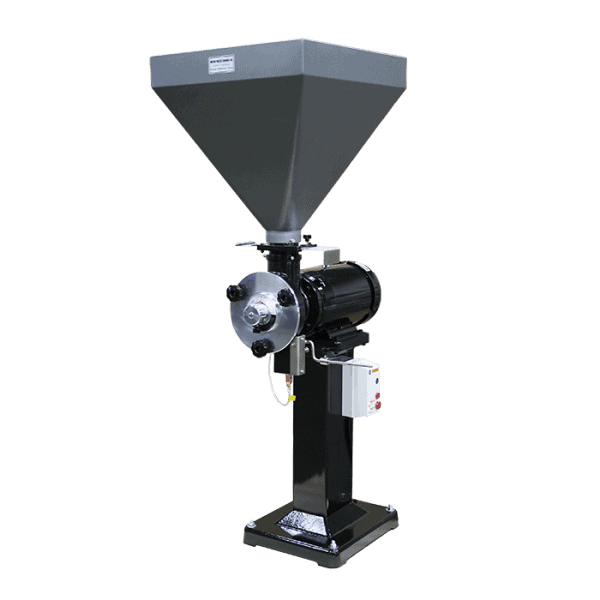
简体中文 Disc Grinder Technical Support
Frequently Asked Questions
Why is my grinder not grinding as well as it used to?
There are potentially many culprits to the decrease in grind quality over time of your grinder. However, with regular maintenance, your grinder should easily be able to achieve a grind as good as the day it was built.
- Replace your discs if they are dull. Depending on the grind, your discs may need replacement after 60,000 lb (27,000 kg) of coffee or even sooner.
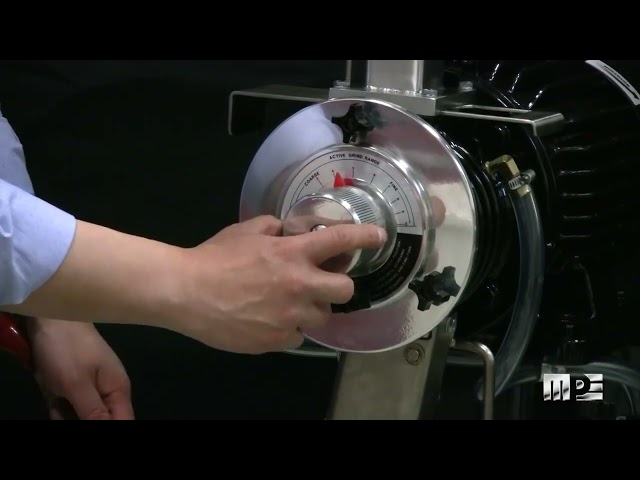
- Recalibrate your grinder regularly, depending on your usage.
- Periodically clean the inside of your grinder (locked out of power)
- Make sure that you are not missing any parts and to inspect the adjusting screw (and bearing), detent plate, and dial plate if experiencing poor grind.
The grinder is “on,” but hardly any coffee is coming through the grinder and it is very inconsistent.
Your 3 phase motor may be wired in reverse. Swap any two of the three wire leads (typically on the NEMA plug, if that’s installed). Do not swap the ground wire though (typically green). Swapping any two of the three wires will reverse the direction of your 3 phase motor. However, this will not work for single phase motors. If you have a single phase motor, the motor will always run in the correct direction.
Coffee is shooting out of the grinder spout unusually fast.
Check your dechaffing gate. Is it broken or bent?
The rotor isn’t coming off the shaft.
There are two screws (1/4″ 20 Thread screws at 2.5″ length) you can put inside the rotor insert to safely dislodge the rotor from the shaft. Because the tolerance between the rotor insert and shaft is very tight, over time the shaft’s end may wear and create high points. Use a file to level out the shaft’s edges until the rotor can fit and release easily from the shaft.
My grind setting is changing during grinding.
Is your locking nut missing? Sometimes it falls off and customers may forget it exists to lock the dial in place during grinding.
Should I add grease to my motor?
The bearings inside the GPX and GPC motors are sealed. Meaning, even if you add grease to the motor through the grease fittings, the grease doesn’t have anywhere to go. There’s no need to add grease to your motor.
Can I replace the motor?
While in theory the motor can be replaced, we never recommend this as an in-field repair. The burr housing is attached to the motor perpendicular to the motor shaft within a 0.001″ tolerance (about 25 microns), which requires special instrumentation.
Why is my grinder’s amperage overload protector tripping?
Your grinder may not be getting the proper voltage from your power source through all of the leads. You’ll want to test this with a multimeter.
Why does my grinder shut off randomly?
Make sure the right voltage is getting to your grinder. If the voltage is too low, the motor draws more amps than is allowed by the overload relay inside the power box. You can use a multimeter to measure voltage and a clamp meter to measure amperage. For reference, the overload relay setting on a GPX should be the following:
220 V single phase model, this limit is set to 19 A
220 V 3 phase model, this limit is set to 12 A
380 V 3 phase model, this limit is set to 6 A
460 V 3 phase model, this limit is set to 6 A
For a GPC model the limits are different. Call us if you need the limits on your GPC overload relay.
Videos
-

Replacing Discs on MPE GPX
-
Calibrating the MPE GPX
-
Cleaning the MPE GPX
-
Dechaffing Gate on MPE GPX Explained
-
Replacing Dechaffing Gate on MPE GPX
-
Proper Use of Dechaffing Gate on MPE GPX
-
Testing Voltage on a Single-Phase MPE GPX
-
Testing Voltage on a Three-Phase MPE GPX
-
Replacing an Overload Relay on MPE GPX
-
Refilling Coolant on MPE GPX.WCI
-
Testing Voltage on MPE GPX.WCI