 Deutsch
  English
  Español
  Français
  Indonesia
  Italiano
  Nederlands
  Português
  العربية
  日本語
日本語  简体中文
简体中文 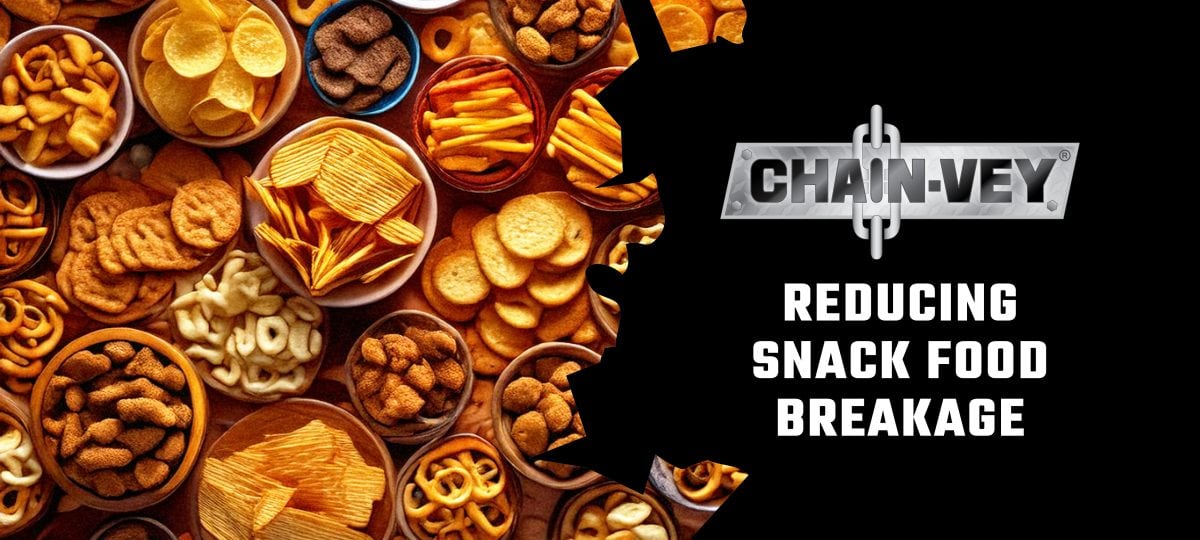
Product breakage is one of the most persistent challenges in snack food production, one that cuts directly into yield, efficiency, and profit margins. Many plants lose 8–15% of their finished product during conveying due to chips, pretzels, crackers, or cookies fracturing in transit. For a facility producing 50,000 lbs per day, that equates to 4,000–7,500 lbs of waste daily, or $2.5–$7.5 million annually in lost product value.
Breakage affects more than yield: it generates fines, complicates sanitation, and lowers overall equipment efficiency. Reducing breakage is one of the fastest ways to improve both quality and profitability in snack production.
Why Conventional Conveyors Cause Breakage
Product breakage typically results from impact, vibration, and uncontrolled movement. Traditional conveying methods (such as bucket elevators, vibratory conveyors, or open belt systems) create these conditions by design.
- Transfer Points: Each time product drops between conveyors or into hoppers, it experiences an impact. These repeated drops fracture fragile snacks, even at short heights.
- Vibration: Vibratory systems used for metering or alignment can induce micro-fractures. Over time, those small cracks propagate into visible breakage.
- Open Systems: In open or exposed conveyors, product collides with sidewalls or other pieces, further increasing damage risk.
- Elevator Discharges: Bucket elevators, in particular, release product in free-fall—causing chips and crackers to shatter on impact.
Even pneumatic and screw conveyors can cause attrition, as products collide with each other or equipment surfaces at high speeds. The result: cumulative damage at every transition point.
A Gentle Alternative: Enclosed Tubular Drag Conveyors
Chain-Vey tubular drag conveyors eliminate nearly all the common causes of breakage. Within a sealed tube, a chain fitted with circular discs gently pulls the product along at a controlled speed. The system moves material horizontally, vertically, or at any angle— without drops, air blasts, or vibration.
- No Transfer Points: The enclosed path runs continuously from process to packaging. There are no free-fall drops, so chips and cookies are never exposed to impact.
- Cushioned Transport: Products ride in evenly spaced pockets between smooth discs, protected from vibration and collision.
- 3D Routing: The system handles elevation and directional changes internally, removing the need for separate elevators or conveyors— and eliminating their associated breakage zones.
The result is a smooth, cushioned conveying environment that moves fragile products gently and consistently. In many installations, MPE customers have reported 40–60% reductions in breakage, and in some cases, near-zero product damage through the conveying process.
Proven Breakage Reduction & ROI
Consider a typical snack facility producing 50,000 lbs per day of potato chips valued at $2.50 per pound. With traditional conveyors and a 12% breakage rate, roughly 6,000 lbs are lost daily—worth $15,000 per day.
After installing a Chain-Vey system that brings breakage down to 5%, daily waste drops to 2,500 lbs (about $6,250 per day). That’s a daily savings of $8,750, or roughly $2.19 million per year (assuming 250 operating days per year)!
Input your own values to see potential savings when switching to Chain-Vey:
Chain-Vey Breakage ROI Calculator
Traditional Conveyors
Chain-Vey Tubular Drag Conveyors
Breakage with Chain-Vey can be as low as 1% depending on the application!
Beyond Breakage: Additional Benefits
Product Protection & Sanitation — The sealed, dust-tight tube protects both the product and the environment. There’s no spillage or dust escaping, and minimal product residue left behind. With optional Clean-in-Place (CIP) capability, the interior of the conveyor can be fully sanitized between runs—helping processors meet stringent food safety standards.
Space Efficiency & Layout Flexibility — Chain-Vey’s ability to route vertically and horizontally within a single system allows for compact, custom layouts that fit within existing plants. It can replace multiple conveyors and elevators, reducing floor space and simplifying product flow.
Reliability & Low Maintenance — With fewer moving parts than belt or bucket systems, Chain-Vey delivers long service life and minimal maintenance. The robust chain-and-disc design resists wear, stretching, or breakage—helping maintain uptime and throughput.
Energy Efficiency & Quiet Operation — Tubular drag conveyors are significantly more energy-efficient than pneumatic systems, using a fraction of the power for equivalent throughput. Operation is also quieter, improving the working environment for plant personnel.
Conclusion: Protecting Product & Profit
Every broken chip or cracked cookie represents wasted effort, materials, and revenue. Conventional conveyors often accept that loss as part of doing business, but it doesn’t have to be.
Chain-Vey tubular drag conveyors demonstrate that gentle handling, efficient layout, and food-safe design can coexist in a single system. By eliminating drop points, reducing vibration, and keeping product enclosed, processors can achieve up to 60% less breakage, cleaner operations, and rapid ROI.
For operations engineers and plant managers, upgrading to a modern tubular drag conveyor can be one of the most cost-effective steps toward improving yield, quality, and overall equipment performance in snack food manufacturing.